For Enquiry
+(91) 9909925266
ppe@pharmatechprocess.com
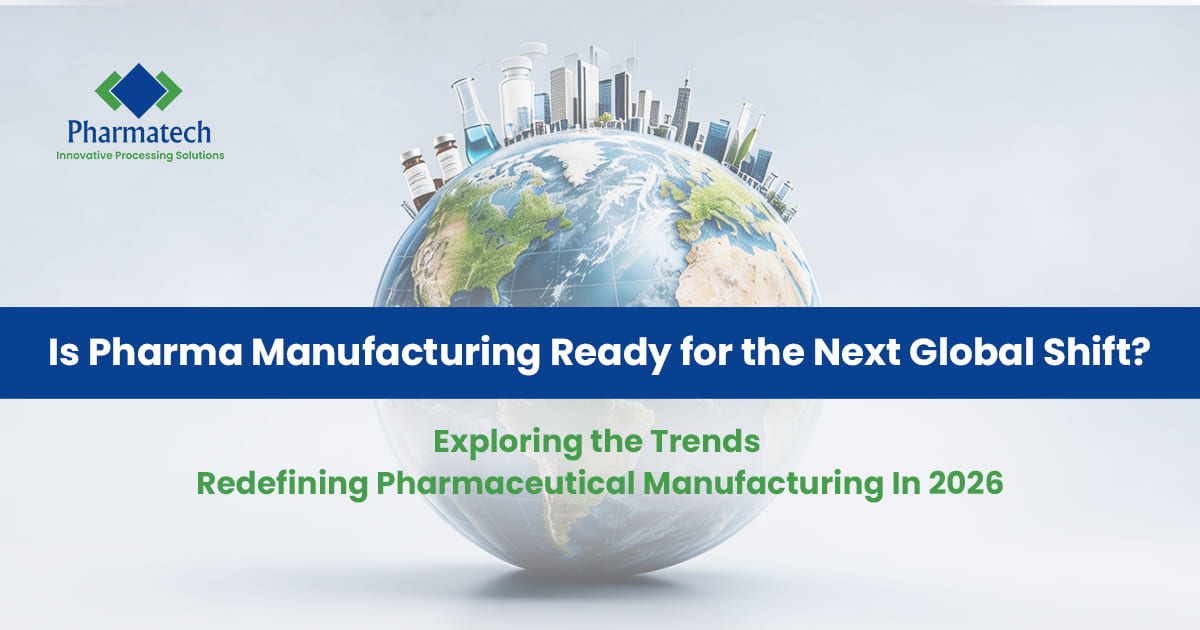
The pharmaceutical industry in 2026 is undergoing a major transformation driven by evolving global policies, economic pressures, and rapidly changing market expectations. These developments are not only impacting drug pricing and innovation but are also reshaping pharma manufacturing strategies in 2026.
To remain competitive, pharmaceutical manufacturers are increasingly focusing on flexible production systems, advanced automation, GMP-compliant equipment, and optimized processing operations. These changing priorities are influencing the future of pharmaceutical manufacturing across global markets.
As companies navigate regulatory complexities and supply chain challenges, adopting scalable and efficient manufacturing solutions has become essential for long-term growth and operational resilience.
Pharma manufacturing strategies in 2026 focus on improving production efficiency, strengthening regulatory compliance, and building resilient supply chain networks.
Modern pharmaceutical manufacturers are increasingly investing in:
These strategies help manufacturers improve operational flexibility while ensuring consistent product quality and compliance with evolving regulatory standards.
Global trade policies and increasing tariffs are significantly impacting pharmaceutical production costs. As a result, manufacturers are re-evaluating supply chain structures and investing in regional production capabilities.
Companies are increasingly focusing on:
This shift toward localized manufacturing has become a major part of emerging pharma industry trends in 2026
Evolving regulatory standards are driving the need for improved compliance-focused manufacturing systems. Pharmaceutical companies are prioritizing:
The adoption of advanced CIP SIP systems in pharma manufacturing is also increasing to ensure operational efficiency and regulatory compliance.
Global pricing reforms and increasing market competition are putting pressure on pharmaceutical profit margins. Manufacturers are focusing on improving operational efficiency and reducing production costs through:
These operational improvements are becoming critical for maintaining profitability in a competitive pharmaceutical market.
To reduce risks associated with global supply chain disruptions, pharmaceutical companies are increasingly adopting localized and regional manufacturing models.
This approach helps manufacturers:
Localized manufacturing is becoming a core component of modern pharma manufacturing strategies in 2026.
The growing demand for personalized medicines and smaller production batches is increasing the need for flexible manufacturing operations.
Manufacturers are adopting:
These flexible manufacturing models help pharmaceutical companies improve adaptability and production efficiency
Speed-to-market has become a major competitive factor in pharmaceutical manufacturing. Companies are focusing on:
Maintaining high product quality remains essential in pharmaceutical production. Manufacturers are increasingly investing in:
These investments support consistent product quality and stronger regulatory compliance
Automation continues to play a major role in transforming pharmaceutical manufacturing operations. Companies are increasingly implementing:
These technologies improve manufacturing accuracy, consistency, and operational efficiency.
Modern pharmaceutical manufacturers are leveraging data analytics to improve manufacturing performance and decision-making.
Data-driven manufacturing helps companies:
The integration of digital technologies is becoming a key part of future-ready pharmaceutical manufacturing trends.
To remain competitive in evolving global markets, pharmaceutical companies are focusing on:
These priorities are shaping the next generation of pharmaceutical manufacturing strategies.
Global policy changes, evolving regulations, and shifting market expectations are redefining pharma manufacturing strategies in 2026. To remain agile, resilient, and market-ready, pharmaceutical manufacturers must invest in flexible, compliant, and technology-driven production systems that enhance efficiency, quality, and operational resilience.
As the industry continues to evolve, Pharmatech Process Equipments remains committed to supporting pharmaceutical manufacturers with advanced processing solutions, automation-enabled systems, GMP-compliant equipment, and scalable manufacturing technologies. By helping companies optimize operations, strengthen compliance, and adapt to changing market demands, Pharmatech Process Equipments plays a key role in enabling the next generation of efficient, compliant, and future-ready pharmaceutical manufacturing facilities.
+(91) 9909925266
ppe@pharmatechprocess.com
Plot No:9 & 10, Mahagujarat Industrial Estate, Village: Moraiya, Sarkhej- Bavla Road, District: Ahmedabad, Gujarat-382213, India.

Developed and Managed by Xenia Consulting